
Chapter 06 / 10
Skin Is an Ecosystem
What affects skin health besides skincare?
When most of us think about skin, we think about what we can see. A breakout. A wrinkle. Dryness. Redness. Dark spots. Oiliness.
We experience skin through its expression. It's understandable. After all, the skin is the part of us we can look at every day.
But what if looking at skin only through what we can see is a little like judging the health of a forest by looking at a single tree?
You might notice a few brown leaves. You might see a broken branch. You might recognize that something about that tree looks different.
But you wouldn't understand the forest until you looked at everything around it. The soil. The water. The weather. The surrounding plants. The organisms living within it. The relationships between all of those things.
A forest isn't simply a collection of trees.
It's an ecosystem.
Your skin is, too.
Nothing Happens Alone
One of the greatest misconceptions in skincare is the belief that problems happen in isolation.
Dryness seems like a moisture problem. Acne seems like an oil problem. Sensitivity seems like a product problem. Pigmentation seems like a pigment problem. Wrinkles seem like an aging problem.
And once we've identified the visible problem, we're naturally directed toward the product designed to address it.
But biology rarely organizes itself into neat little categories. Your skin doesn't know that today is supposed to be “acne day.” It doesn't separate your sleep from your stress. It doesn't separate your environment from your routine. It doesn't experience one product without experiencing everything else happening around it.
Everything arrives in context.
Your Skin Lives Your Life Alongside You
This may be one of the most important ideas in this book. Your skin doesn't live in your bathroom. It lives alongside you.
It comes with you to work. Outside. To bed. To the gym. On vacation. Through the seasons. Through stressful weeks. Through restful weeks. Through changes in routine. Through changes in environment. Through changes in life.
Your skin experiences your:
Sleep. Stress. Hormones. Environment. Habits. Exposures. Products. Treatments. History.
None of these things exists in a separate compartment from your skin. They are part of the context in which your skin operates.
That doesn't mean every change in your skin can be attributed to any one of them. It means that when we're trying to understand why skin behaves differently, we shouldn't pretend the skin is operating independently of the life around it.
The Skin You See Is the Skin That Has Been Living
Think about how strange it would be to evaluate someone's life by looking at them for five seconds.
You wouldn't know whether they slept well last night. You wouldn't know whether they've been traveling. You wouldn't know whether they've been under unusual stress. You wouldn't know whether their environment had changed. You wouldn't know what their routine looked like six months ago.
You'd have a snapshot. But you'd be missing the story.
Skin is similar. What you see in the mirror is an expression of a living system at a particular moment. It's useful information. But it isn't the whole story.
The skin you see has been living.
Why Your Skin Can Change When Your Routine Doesn't
This is one of the questions that makes the ecosystem idea immediately relevant.
You haven't changed your products. You haven't changed your routine. And yet your skin looks different.
Maybe it suddenly feels different. Maybe something that was comfortable isn't anymore. Maybe your skin seems more reactive. Maybe it looks duller. Maybe something you haven't thought about in months suddenly becomes noticeable.
The natural response is:
What product should I change?
But before we change the product, there is another question worth asking.
What changed around the skin?
Maybe nothing obvious. Maybe something subtle. Maybe several things at once.
The point isn't that we can always identify a single cause. The point is that the routine isn't the only variable.
The Life Around Your Skin Matters
Consider sleep. We don't need to claim that one bad night's sleep will suddenly transform your skin. That's not the point. The point is that sleep is part of the biological environment in which your skin exists.
The same is true of stress. Hormonal changes. Weather. Environmental exposures. Daily habits. Travel. Exercise. Treatments. Products. History.
These factors don't operate like individual switches. They coexist. They overlap. They change. And your skin experiences the whole environment.
That's what makes an ecosystem an ecosystem.
We Keep Separating What Skin Doesn't
Skincare has a tendency to divide the face into problems.
Here is the problem. Here is the ingredient. Here is the treatment. Here is the solution.
But your skin doesn't experience itself that way.
The same skin can be dealing with dryness and sensitivity. Oiliness and dehydration. Breakouts and irritation. Pigmentation and environmental exposure.
Multiple things can be true at the same time. And when one thing changes, other things may appear to change with it.
That doesn't mean there is always a simple cause-and-effect relationship. It means the system is interconnected.
This Is Why Context Matters
If we want to understand why a product works for one person and not another, we can't stop at the product. We have to look at the environment in which the product meets the skin.
And if we want to understand why a product worked for you six months ago but doesn't seem to work the same way today, we have to consider what may have changed in the environment surrounding your skin.
That is what context gives us. Not an excuse. Not a diagnosis. Not a guarantee.
A bigger picture.
Your Skin Has a History
Your skin doesn't start over every morning. It carries history.
The products you've used. The treatments you've received. The environments you've lived in. The patterns you've repeated. The experiences your skin has had. The changes it has already navigated.
That doesn't mean your past determines your future. It means the skin you're caring for today is not an untouched surface.
It's the skin that got you here.
And that matters when we make decisions about what to ask of it next.
The Snapshot Problem
We love snapshots because they're easy.
This is what my skin looks like. This is what her skin looks like. This is what my skin looked like before. This is what it looks like after. We can compare them.
But a snapshot doesn't tell us everything that produced the expression we're seeing. And it certainly doesn't tell us everything happening outside the frame.
That's why a before-and-after photograph can be compelling without being a complete explanation. It shows us an outcome.
It doesn't necessarily show us the ecosystem that produced it.
The Ecosystem Changes
A forest doesn't remain identical from one day to the next. Neither does your skin.
The conditions around it change. The environment changes. Your routines change. Your habits change. Your body changes. Your circumstances change.
Sometimes those changes are obvious. Sometimes they're not.
This is why “What worked before?” can be a useful question without being the final question. The better question may be:
“What is true about my skin now?”
Because today's skin is operating in today's context.
This Doesn't Mean You Have to Control Everything
Once people hear that life affects skin, it's easy to imagine an impossible assignment.
Sleep perfectly. Never experience stress. Eat perfectly. Avoid every environmental exposure. Never change your routine. Control your hormones. Eliminate every variable.
That's not what I'm suggesting. You are a person. You are going to live your life. Your skin is going to live it with you.
The point of understanding context isn't to create a perfectly controlled life.
It's to stop pretending that a perfectly controlled life is required to make sense of your skin.
You don't need to control everything. You need better information about what is happening.
This Changes How We Think About Products
Once we understand skin as an ecosystem, the product question becomes more interesting.
Instead of:
“What product treats this problem?”
we can ask:
“What is happening within the ecosystem that I'm asking this product to enter?”
Instead of:
“What ingredient should I add?”
we can ask:
“What is my skin already dealing with?”
And instead of assuming that more intervention is always better, we can ask:
“What would actually help in this context?”
Those questions don't tell us to do less. They help us make more informed choices about what we do.
The Skin Has Its Own Agenda
There is another piece of this puzzle. Your skin isn't simply waiting for you to tell it what to do. It already has work to perform. Every day. Every 24-hour cycle.
It is carrying out biological processes that are part of maintaining itself while simultaneously navigating the conditions around it.
And that means something important:
Your skincare goals are not the only requests your skin is managing.
This is where the ecosystem idea leads us next. Because if your skin is living alongside you, and if it has its own biological work to perform, then we need to understand what happens when the conditions around it repeatedly interrupt that work.
The Question Becomes Bigger
We began this chapter with a simple question:
What affects skin health besides skincare?
The answer isn't one thing. It's the ecosystem.
Your sleep. Your stress. Your hormones. Your environment. Your habits. Your exposures. Your products. Your treatments. Your history. And the interactions among them.
The important thing isn't to turn every life variable into a skincare explanation. It's to recognize that your skin is living within all of them.
Once we understand that, we can stop asking why our skin isn't behaving like an isolated surface. It isn't one.
It's an ecosystem.
And an Ecosystem Has Work to Do
This is where the story gets more interesting.
Your skin isn't simply reacting to everything around it. It is also doing its own work. Work it is hardwired to perform. Work that happens every 24-hour cycle. And it has to do that work while living your life alongside you.
So what happens when something repeatedly interrupts that work? What happens when patterns in your life create demands your skin has to respond to? And what happens when those demands consume some of the capacity your skin might otherwise have available for the things you're asking it to do?
That's the next part of the story.
The Proof Positive Takeaway
Your skin doesn't live in a bottle. It lives alongside you.
Your skin exists within the context of your sleep, stress, hormones, environment, habits, exposures, products, treatments, and history. That doesn't mean every change has one identifiable cause. It means that skin cannot be fully understood by looking at the product alone.
Before we ask what we want from the skin, we need to understand the ecosystem it's living in.
The next step
Stop guessing. Get your WTH Should I Use? Plan.
Your own Ingredient List, plus every product on your shelf sorted into keep, move or skip. $147, in your hands within 5 days.
Get my WTH Should I Use? Plan · $147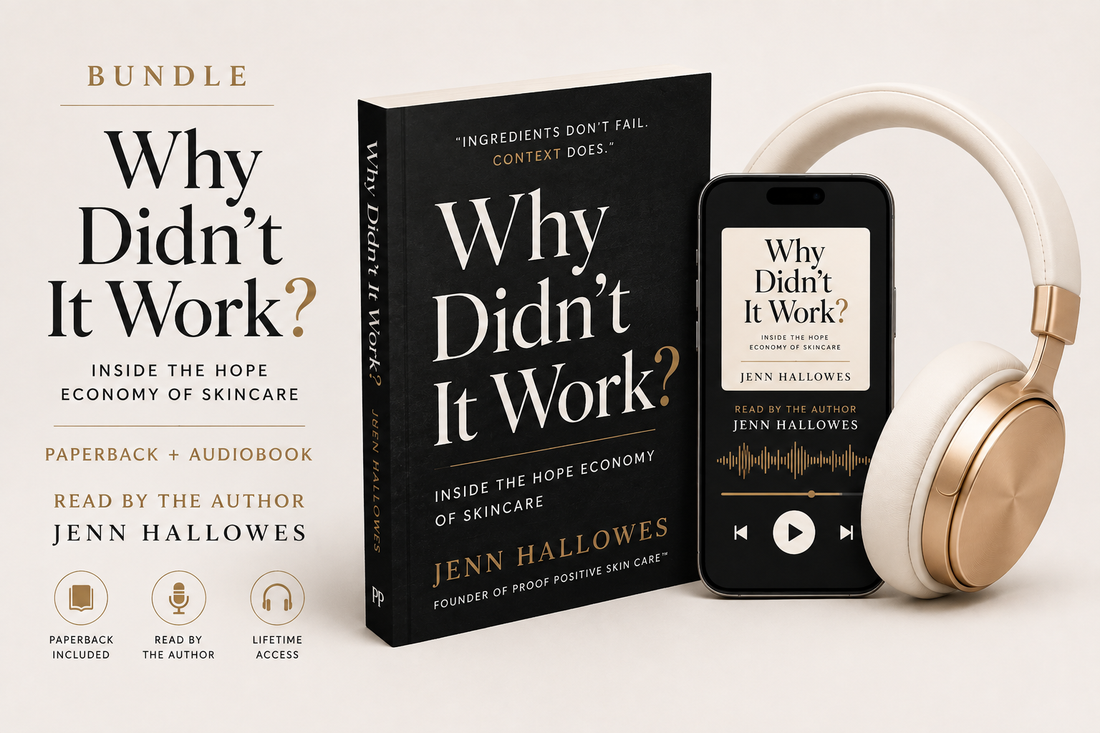
The book
Why Didn't It Work?
All ten chapters, free, right here. The book itself comes in print, or read aloud by Jenn.
Pre-order the book