
Chapter 10 / 10
The End of the Hope Cycle
How do I choose skincare products that are right for me?
We've spent this entire book asking a question that most skincare conversations don't begin with:
Why didn't it work?
We started with the Hope Economy. We looked at the information gap that leaves consumers making decisions without enough context. We looked at the cost of trial and error. We asked why scientifically validated products can produce different experiences.
We looked at the difference between controlled research and living skin. We looked at skin as an ecosystem. We looked at the work your skin is already doing every 24 hours. We looked at the patterns that can create burden responses and steal capacity. And finally, we looked at what happens when the right ingredient meets the wrong context.
Now we can ask the question that all of this was building toward:
What do I do with what I know?
Because understanding your skin isn't supposed to be an academic exercise. It is supposed to change the decisions you make.
We Have Been Starting in the Wrong Place
For a very long time, skincare has trained us to begin with the product.
What should I use? What's the best serum? What ingredient should I add? What's the strongest treatment? What's the newest technology? What worked for her?
The assumption is that the answer is somewhere on the shelf. So we go looking. And if we don't get the result we expected, we look again.
But after everything we've explored in this book, that order starts to feel backwards.
What if the first question isn't:
“What should I buy?”
What if it's:
“What do I understand about my skin?”
Because the product is only one part of the decision. Your skin is another. And the context in which those two meet matters.
Context Comes First
This doesn't mean you need to understand every biological process happening inside your skin. You don't. It doesn't mean you need to become an expert in ingredients. You don't. It doesn't mean you need to diagnose yourself. You shouldn't.
It means you deserve enough meaningful information about your skin to make a more informed decision about what you ask of it.
What is happening? What patterns are present? What is your skin already managing? What may be consuming capacity? What are you trying to accomplish?
And given all of that:
What makes sense right now?
That's the decision-making framework. Not certainty.
Context.
Your Goal Still Matters
I want to return to this because context can easily be misunderstood as a reason to do less. It isn't.
If you want to address the appearance of fine lines, that goal matters. If you want brighter-looking skin, that goal matters. If you want more even-looking skin, that goal matters. If you want your skin to feel more comfortable, that goal matters.
You don't need to lower your expectations simply because your skin is complex. You don't need to decide that wanting results is somehow the problem. And you don't need to abandon ingredients that have legitimate scientific potential.
Keep the goal.
The question is whether you can make a better decision about how and when to pursue it.
The Decision Changes
Imagine two people considering the same product.
The first person thinks:
Everyone says this works. I hope it works for me.
The second person thinks:
I understand what my skin is currently experiencing. I understand what this ingredient is designed to do. I understand what else my skin is managing. I understand the potential burden. And I have a reason to believe this makes sense for me right now.
Neither person has certainty. But they are not making the same decision.
The second person has context. And context changes the quality of the decision.
This Is What HopeLESS Means
At Proof Positive, we believe in HopeLESS skincare. That name can sound strange at first. It shouldn't.
HopeLESS does not mean hopeless.
It means requiring less hope to make a good skincare decision.
Hope can still be part of your relationship with your skin. You can still believe something better is possible. You can still be excited about a new product. You can still pursue change. You can still experiment. You can still discover something wonderful.
What changes is what carries the weight of the decision. Not hope alone.
Understanding.
Hope Was Never the Problem
Hope got us here. It made us willing to try. It made us believe that the next product might help. It made us willing to keep searching.
Hope isn't something I want to take away. I want to take away the burden we've placed on it.
Hope should inspire your skincare journey. It shouldn't have to tell you what to buy. It shouldn't have to determine whether an ingredient makes sense for your skin. It shouldn't have to explain why something worked for someone else but didn't work for you. It shouldn't have to carry the entire weight of an uninformed decision.
You deserve something stronger than hope alone. You deserve understanding.
The End of “What's Best?”
There is no single best skincare product. There is no single best routine. There is no single best ingredient for every person at every moment.
That doesn't mean nothing works. It means “best” is an incomplete question.
Best for whom? Best for what goal? Best under what conditions? Best at what point in time? Best given what the skin is already managing?
Once you start asking those questions, skincare becomes less about finding the universal answer and more about finding the appropriate answer.
The End of “It Worked for Her”
Someone else's success can still be interesting. It can introduce you to an ingredient. It can give you something to investigate. It can show you what may be possible.
But it doesn't make her experience your instruction manual. Her skin had its own context. You have yours.
So instead of asking:
“What did she use?”
you can ask:
“What was true about her situation—and what is true about mine?”
That doesn't make other people's experiences irrelevant. It puts them in the right place.
Information, not instruction.
The End of “My Skin Is the Problem”
There is another cycle I want to end. The one where something doesn't work and you decide your skin must be the problem.
Maybe your skin is too sensitive. Maybe it's too difficult. Maybe it doesn't respond normally. Maybe nothing works for you. Maybe you're just one of those people.
But what if the problem isn't that your skin is failing to cooperate? What if you simply haven't had enough context to understand what you're seeing?
That doesn't mean every problem has an easy explanation. It means your skin deserves investigation before judgment.
Your skin isn't an obstacle to the solution. It's part of the information needed to find one.
The End of Starting Over
Think about what happens when you understand why something didn't work.
You don't necessarily need to throw everything away. You don't necessarily need to buy something new. You have learned something.
Maybe the ingredient wasn't appropriate. Maybe the formulation wasn't appropriate. Maybe the timing wasn't appropriate. Maybe the context wasn't appropriate. Maybe something else was consuming capacity.
Whatever the answer, you have information you can carry forward. That is how you begin to break the trial-and-error cycle. Because you're no longer starting from zero.
Every experience can become context.
What If Your Bathroom Became a Place of Decisions, Not Hope?
Imagine opening your cabinet and understanding why each product is there.
Not because someone told you that you need it. Not because it went viral. Not because it worked for someone else. Not because you were afraid you were missing something.
But because you understand its role. You know what you're asking of your skin. You understand the context in which you're asking it. You understand what you're watching for.
And when something changes, you know to ask questions before automatically adding another product.
That is a very different bathroom. And a very different relationship with skincare.
You Don't Need to Know Everything
This may be the most liberating part.
You don't need to become a dermatologist. You don't need to memorize every ingredient. You don't need to understand every clinical study. You don't need to have an opinion about every new product. You don't need to follow every skincare trend. You don't need to know what everyone else is doing.
You need enough information to make your next decision better. That's it. Then the decision after that. And the one after that.
Understanding compounds.
This Is Why Understanding Is So Valuable
A product is something you use. A treatment is something you receive. A recommendation is something someone gives you.
But understanding is something you keep.
You can take it into your next purchase. Your next appointment. Your next conversation. Your next season. Your next skincare decision.
And if your context changes, your understanding gives you a way to reconsider the decision. That is why I believe understanding isn't simply something that happens on the way to buying skincare.
Understanding is the thing worth having.
Proof Positive Has a Different Job
This is the reason Proof Positive exists.
We aren't trying to become the next place that tells you what product to buy. We are trying to help you understand your skin well enough to make better decisions about products and services.
Including products we don't sell. Including services we don't provide.
Because if the information is useful, it shouldn't stop being useful simply because you walked outside our business. You should be able to take it with you.
To the retailer. To your esthetician. To your dermatologist. To another brand. To your own bathroom.
The information belongs with you.
The Skin Score Is Where This Becomes Practical
This is where the philosophy becomes something you can actually use. Instead of starting with a product, you can start with your skin.
Instead of asking:
“What should I buy?”
you can begin asking:
“What is my skin telling me?”
Instead of collecting more opinions, you can begin organizing the information you already have.
The purpose isn't to produce another label. It isn't to tell you that you're simply “dry,” “oily,” “sensitive,” or “combination.” It's to help create a more useful picture of the skin you're actually living with.
Because once you have that picture, the next decision becomes more informed.
The Point Isn't to Predict Everything
Let's be realistic. Context doesn't give you a crystal ball.
There will still be surprises. There will still be products that don't work. There will still be changes you can't anticipate. There will still be experimentation. Biology doesn't offer guarantees.
But there is an enormous difference between:
“I hope this works.” and “Based on what I understand about my skin, this makes sense to try.”
The second decision can still be wrong. But it is an informed decision. And when the outcome isn't what you expected, you have a better chance of learning from it.
The Trial Doesn't Have to Become a Tax
This is perhaps the ultimate shift.
You may still experiment. But experimentation can become a way of learning rather than a permanent state of guessing.
You try something. You observe. You understand the context. You learn. You adjust. You move forward.
You don't automatically erase everything and begin again.
You accumulate understanding.
And the more understanding you accumulate, the less dependent you become on hope to make the next decision.
This Is What We Mean by HopeLESS
HopeLESS skincare isn't about taking hope away. It's about taking guesswork out of the driver's seat.
It's about moving from:
Hope → Purchase
to:
Understanding → Context → Choice
Hope can still come along for the ride. But it doesn't have to drive.
The Question You Take With You
So the next time you see a product that promises something you want, I don't want you to automatically ask:
“Will this work?”
Ask:
“Why might this make sense for my skin?”
And then:
“What is true about my skin right now?” “What is my skin already managing?” “What patterns are present?” “What might be consuming capacity?” “What am I asking this ingredient to do?”
And finally:
“Does this request make sense right now?”
That is a very different way to shop for skincare.
The Hope Cycle Ends Differently Than You Think
The end of the Hope Cycle isn't the moment you stop buying skincare. It's not the moment you stop trying new things. It's not the moment you stop believing your skin can change. It's not the moment you stop wanting more.
It's the moment you stop needing hope to be your primary reason for buying.
You still have goals. You still have choices. You still have products. You still have science. You still have professionals. You still have possibility.
But now you have something else.
Context.
And context gives you a reason.
A Different Way Forward
We began this book with a simple question:
Why didn't it work?
Maybe the product was wrong. Maybe the ingredient was wrong. Maybe the formulation was wrong. Maybe the expectations were wrong. Maybe the timing was wrong. Maybe the context was wrong.
The point was never to find one explanation that applies to everyone. The point was to stop assuming that the only answer is:
“Try something else.”
Sometimes the answer is another product. Sometimes it's a different product. Sometimes it's a different time. Sometimes it's a different approach. And sometimes the most valuable thing you can do is understand what's happening before you make the next decision.
That is the shift.
The Question Was Never Really About the Product
After all these chapters, I think we can finally see what the question “Why didn't it work?” was really asking.
It wasn't simply:
“Which product failed?”
It was:
“What happened when this product met this skin?”
And once we ask that question, the entire skincare conversation changes.
We can keep the science. We can keep the products. We can keep the treatments. We can keep the goals. We can keep the hope.
We simply add what was missing:
an understanding of context.
The End of the Hope Cycle
The skincare industry doesn't need another person telling you what to buy. You already have plenty of people doing that.
What you need is a better reason to decide. That's what this book has been about.
Understanding your skin. Understanding its context. Understanding what it is already managing. Understanding what may be consuming its capacity. Understanding what an ingredient is asking it to do.
And then making a choice.
Not because someone promised you an outcome. Not because everyone else is doing it. Not because you are afraid of missing the answer. Not because you hope this time will be different.
But because you understand why it makes sense.
The Goal Isn't Certainty
There is one final thing I want you to take with you.
I cannot promise you that understanding your skin will make every product work. No one can. I cannot promise that context will eliminate disappointment. It won't. I cannot promise that you will always know exactly what your skin needs. Biology doesn't work that way.
But I can tell you what I believe understanding can do.
It can make you a better decision-maker. It can make disappointment more informative. It can make recommendations easier to evaluate. It can make purchases more intentional. It can help you recognize when something doesn't make sense.
And it can help you stop confusing another possibility with an answer.
The Goal Isn't Certainty. It's Context.
That's where I want to leave you.
Not with a list of products. Not with a perfect routine. Not with another set of rules.
With a question.
The next time you're about to buy something for your skin, ask:
Why?
Why this? Why now? Why for this skin? What do I know? What don't I know? And what does my skin's context tell me?
Because maybe the most important skincare decision isn't choosing the right product.
Maybe it's knowing why you're choosing it.
HopeLESS
At Proof Positive, we believe skincare should require less hope. Not less possibility. Not less ambition. Not less desire.
Less guessing.
Hope can stay. The goals can stay. The science can stay. The products can stay.
What changes is the starting point.
Understanding first. Context next. Choice after that.
And when you make the choice, you don't have to wonder whether you're simply hoping for the best. You have a reason.
Why Didn't It Work?
Maybe that's the question we should have been asking all along.
Not so we could find someone to blame. Not so we could find another product. Not so we could give up. But so we could learn.
Because every time something doesn't work, there is an opportunity to understand more. And the more we understand, the less we have to guess. The less we guess, the less we have to rely on hope. And the less we rely on hope, the closer we get to something better:
Skincare based on what we actually know about the skin receiving it.
That is HopeLESS skincare. And that is the end of the Hope Cycle.
The Proof Positive Takeaway
The goal isn't to eliminate uncertainty. It's to make better decisions in the presence of it.
You don't need to know exactly what will happen before you make a skincare decision. You need enough context to understand why the decision makes sense.
Keep your goals. Keep the science. Keep the possibility. Just stop making hope do all the work.
Understand your skin. Understand the context. Then choose.
That is the beginning of HopeLESS skincare.
The Book's Argument
Why didn't it work?
Because a product doesn't meet “skin.” It meets your skin.
And your skin doesn't exist in isolation. It lives. It works. It responds. It carries context.
So before you ask what your skin needs from the next product, ask what your skin is already experiencing.
Ask your skin.
Then decide.
The next step
Stop guessing. Get your WTH Should I Use? Plan.
Your own Ingredient List, plus every product on your shelf sorted into keep, move or skip. $147, in your hands within 5 days.
Get my WTH Should I Use? Plan · $147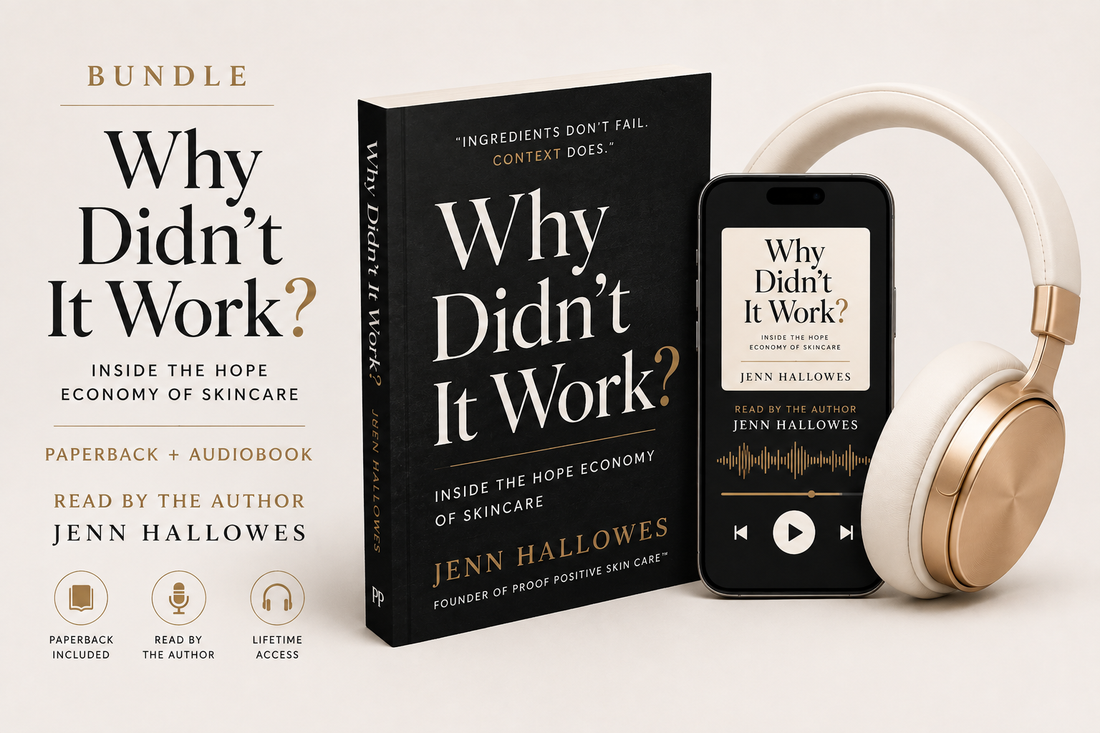
The book
Why Didn't It Work?
All ten chapters, free, right here. The book itself comes in print, or read aloud by Jenn.
Pre-order the book