
Chapter 04 / 10
The Question Behind the Question
If skincare science is proven, why didn't it work for me?
This is the question that started everything for me.
Not What is the best product? Not What ingredient should everyone be using? Not What should I buy next?
A much simpler question:
Why didn't it work?
Because if you've spent any amount of time with skincare, you've probably experienced the strange contradiction. Something works beautifully for someone else. Sometimes it works beautifully for thousands of people. Sometimes it even works beautifully for you—until suddenly it doesn't.
And then you're left wondering what happened.
Was the product wrong? Was your skin wrong? Did you use it incorrectly? Did you need to use more? Less? Something different? Did your skin suddenly change? Or did the product simply stop working?
These questions sound simple. They're not.
The Question Behind the Question
For the past decade, I've been trying to understand something that seems, at first, almost impossible to reconcile:
If skincare products are scientifically validated, and science is repeatable, why does a product work for one person but not the next?
Science depends on repeatability. If something works under a particular set of conditions, we should be able to observe that effect again under those conditions.
And modern skincare has become extraordinarily sophisticated at demonstrating that ingredients can do particular things. We study them. We test them. We measure them. We formulate products around them. We develop increasingly precise ways of delivering them to skin.
So why doesn't the experience always translate? Why can two people use the same product and walk away with completely different impressions? Why can something be an excellent product and still not be the right product for you? And why can something that once worked for your skin eventually stop feeling like the right answer?
For a long time, the easiest explanation was simply:
Everyone's skin is different.
True. But that never felt like a complete answer.
I wanted to know:
Different how? Different when? Different because of what?
We Keep Looking at the Product
When something doesn't work, our attention naturally goes to the thing we purchased.
Was the product defective? Was the formulation bad? Was the ingredient overhyped? Was the concentration too low? Was the marketing misleading?
Sometimes those questions are worth asking. But what if we're missing another part of the equation?
The product is one variable.
The skin receiving it is another.
And the skin receiving it isn't sitting still. It isn't a blank surface waiting for an ingredient. It's alive. It's responding. It's adapting. It's carrying out its own biological work while simultaneously existing within everything else happening to you.
That means the product isn't entering the same environment every time. Even when the bottle hasn't changed.
The context may have.
The Same Product Doesn't Meet the Same Skin
Imagine two people using the exact same serum.
Same ingredient. Same concentration. Same instructions. Same amount. Same frequency.
One person loves it. The other person doesn't.
Our instinct is to decide that one of them must be wrong. But what if neither is wrong? What if the product is doing what it was designed to do, while the two people's skin is experiencing that product under different conditions?
Now change the equation again. Imagine the same person using the same product six months apart.
Same person. Same product. Same ingredient. Different experience.
What changed? The bottle? Maybe not.
The person did.
And by that I don't mean that you suddenly became a different person. I mean that your skin is a dynamic biological system. The conditions surrounding it can change. And when those conditions change, the way your skin experiences everything else can change with them.
This Doesn't Mean the Science Was Wrong
This distinction is critical.
If a product doesn't work for you, it doesn't automatically mean the science behind it was wrong. And if it works for you, it doesn't mean you've discovered a universal solution.
A scientifically supported ingredient can have legitimate potential. A product can be well formulated. The research can be sound. The claims can be appropriately supported. And your individual experience can still be different.
Those things can all be true at the same time. That's not a contradiction. It's what happens when controlled scientific knowledge meets living biology.
And that distinction changed the way I began thinking about skincare.
We Have Been Asking a Product Question
For decades, we've been trained to ask:
Does this ingredient work? Is this product good? What's the best serum? What's the strongest treatment? What works for aging skin? What works for sensitive skin?
Those questions are understandable. But they're incomplete.
Because eventually the question has to become:
What does this ingredient mean for this skin?
And then:
What does it mean for this skin right now?
That is a very different question.
Right Ingredient. Wrong Context.
Consider an ingredient with genuine scientific potential. It may have been studied extensively. It may have produced measurable results. It may have a legitimate role in skincare.
None of that tells us exactly what will happen when it meets your skin on a particular Tuesday.
Because your skin doesn't exist in a laboratory. It exists in your life. It is experiencing whatever conditions you're experiencing. And those conditions can influence what your skin has available to do.
This doesn't make the ingredient bad. It doesn't make the science unreliable. It means the ingredient is only part of the story.
The Missing Variable
This was the realization that kept pulling me deeper.
What if the missing variable wasn't the product? What if it was context?
Not as a vague explanation for why “everyone's skin is different.” Something much more specific.
What is happening in the skin? What is happening around the skin? What patterns are repeatedly showing up? What is the skin already being asked to do? What demands are consuming its capacity? What conditions exist when the product arrives? And what does all of that mean for the skin's ability to respond?
Suddenly, the question becomes much more interesting. Because now we're not trying to determine whether a product is universally good or bad. We're trying to understand the conditions under which it makes sense.
Your Skin Is Not a Constant
We often behave as though our skin is a fixed thing.
This is my skin. This is my skin type. This is my concern. This is my routine. This is what I use. And therefore, this is what I should continue to use.
But your skin isn't static. It changes. The conditions surrounding it change. Your environment changes. Your routines change. Your life changes. And your skin responds to what it experiences.
That means a skincare routine that made perfect sense six months ago may not necessarily make the same sense today.
Not because you bought the wrong product. Not because your skin suddenly became “bad.”
Because context changed.
The Problem With “It Worked for Her”
One of the most powerful forces in skincare is social proof.
Someone uses a product. Her skin looks incredible. She tells you exactly what she used. You buy the same thing. And then you wait for your version of the same result.
When it doesn't happen, you have to explain the discrepancy.
Maybe you tell yourself you need to use it longer. Maybe you need more of it. Maybe you need to add another product. Maybe you need the version with the higher concentration. Maybe you need the product she uses before it. Or after it. Or instead of it.
And once again, you're shopping for the missing answer.
But what if the answer was never simply inside the bottle? What if what worked for her worked in the context of her skin?
And what you're seeing isn't necessarily evidence that you need the same product. It's evidence that her skin and yours are not the same environment.
And Sometimes It Worked for You
This is where the question gets even more interesting. Because sometimes you don't have to compare yourself with anyone else. You can compare yourself with yourself.
You used something. It worked. You loved it. Then something changed. Suddenly your skin doesn't seem to respond the same way.
This is where we often say:
“My skin got used to it.”
Sometimes that may be part of the story. But it may not be the whole story. Something else may have changed.
The season. Your environment. Your routine. Your stress. Your sleep. Your hormones. Another product. A treatment. A habit. Something happening repeatedly in your life.
The important point isn't that any one of these variables automatically explains your skin. It's that your skin exists within them.
And if the context changes, the experience can change.
The Product Didn't Necessarily Fail
This is the distinction I want to make throughout this book.
When something doesn't produce the result we expected, we tend to classify it as a failure.
It didn't work.
But there are actually several different possibilities hiding inside that sentence.
The product may genuinely not have been appropriate. The ingredient may not have addressed the goal. The formulation may not have suited the person. The expectations may not have matched what the product could realistically do. Or the product may have been perfectly capable of contributing to the desired outcome, but the skin was experiencing conditions that changed the equation.
Those are very different explanations. And they lead to very different decisions.
If we assume the product failed every time, the natural response is to find another product. If we ask why it didn't work, we have an opportunity to learn something.
That's the Question I Care About
Not:
“What's the best product?”
But:
“Why didn't it work?”
Because the answer could tell us something. It could tell us about the product. It could tell us about the formulation. It could tell us about the ingredient. It could tell us about expectations. And it could tell us something about the skin that received it.
That's the part we've historically been missing.
We've become exceptionally good at describing what products do. We've become exceptionally good at studying ingredients. We've become exceptionally good at developing treatments.
But understanding what happens when those things meet this particular skin, under these particular conditions is a different problem.
Context Doesn't Make Skincare Less Scientific
It makes the question more scientific. Because context isn't an excuse. It's information.
If two systems produce different outcomes, we should want to know what differed between them. If the same system produces different outcomes at different times, we should want to know what changed.
That's not abandoning science.
That's asking a better question of it.
And this is where my investigation took me. Away from the idea that we simply need better products. Toward the idea that we need a better understanding of the conditions in which products are being used.
Ingredients Don't Fail. Context Does.
I eventually arrived at a phrase that captures this distinction:
Ingredients don't fail. Context does.
I don't mean that literally every product works for every person. It doesn't. And I don't mean that every disappointing experience can be explained by context. It can't.
I mean something more fundamental:
An ingredient's potential cannot be separated from the skin receiving it.
The ingredient brings its properties. The formulation determines how it is delivered. The science tells us what it can potentially do.
But the skin brings everything else.
Its current state. Its history. Its environment. Its patterns. Its demands. Its capacity. Its context.
And that is where the outcome begins to become personal.
The Question Changes Everything
Once you start thinking this way, you can ask different questions.
Instead of:
“What's the strongest ingredient?”
You can ask:
“What is my skin in a position to respond to right now?”
Instead of:
“Why didn't this product work?”
You can ask:
“What was happening with my skin when I used it?”
Instead of:
“What should I buy next?”
You can ask:
“What do I understand about my skin that should influence my next decision?”
These questions don't guarantee an outcome. They don't eliminate uncertainty. They don't turn skin into a predictable machine.
They do something more realistic.
They improve the starting point.
And This Is Where We Have to Look at the Skin Itself
If context is the missing variable, then we need to understand what “context” actually means.
We need to look beyond the product. Beyond the ingredient. Beyond the label. Beyond the snapshot we see in the mirror.
Because the skin is not operating alone. It is part of a living system. It is navigating the conditions around it while carrying out its own biological work.
And that brings us to the next question:
What happens when we try to understand living skin using a model built around controlled conditions?
Because your skin may be the most sophisticated environment your skincare product will ever encounter. And it is nothing like a petri dish.
The Proof Positive Takeaway
The product is only one part of the equation.
A scientifically validated ingredient can have legitimate potential while producing different experiences in different people.
That doesn't mean the science failed. It means the context in which the science meets living skin matters.
Maybe the missing variable isn't the product. Maybe it's the skin receiving it.
The next step
Stop guessing. Get your WTH Should I Use? Plan.
Your own Ingredient List, plus every product on your shelf sorted into keep, move or skip. $147, in your hands within 5 days.
Get my WTH Should I Use? Plan · $147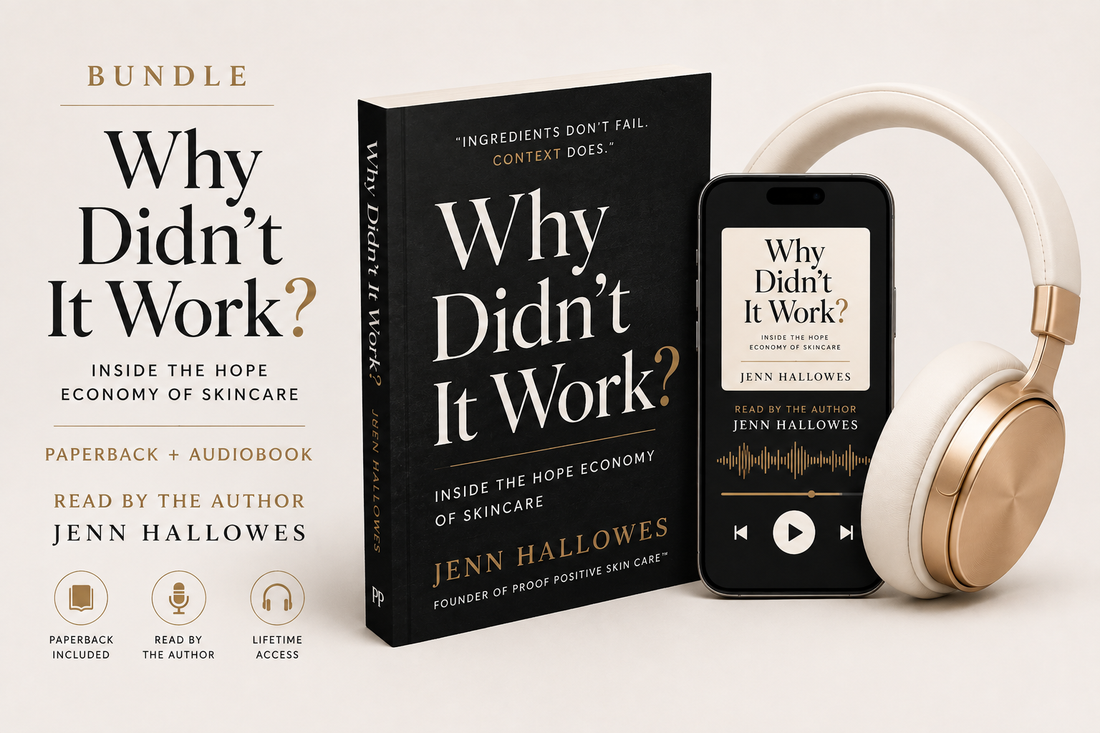
The book
Why Didn't It Work?
All ten chapters, free, right here. The book itself comes in print, or read aloud by Jenn.
Pre-order the book