
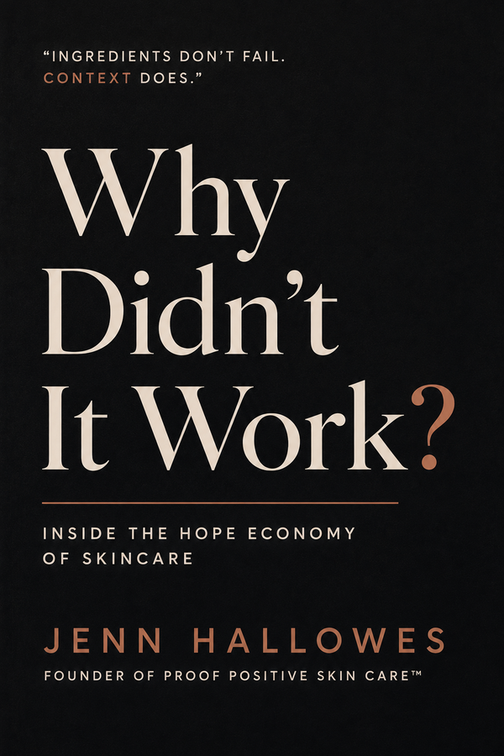
Chapter 03 / 10
The Trial-and-Error Tax
Why do I keep wasting money on skincare?
Walk into almost any bathroom and you'll find evidence of an invisible expense.
Half-used serums. Three different vitamin C products. A moisturizer that felt amazing for two weeks before it suddenly didn't. A retinol that was too harsh. A cleanser recommended by a friend. A product that went viral. A luxury cream purchased after reading hundreds of glowing reviews.
None of these products were necessarily bad. None of these purchases were irrational. They may have all made perfect sense at the time.
They were all attempts to answer the same question:
Will this work for my skin?
And when you don't know the answer, the only way to find out can feel like trying it. That's where the cost begins.
I call it the Trial-and-Error Tax.
The Tax No One Talks About
Most people think the cost of skincare is whatever appears on the receipt.
$48 for a cleanser. $96 for a serum. $150 for a treatment.
But the real cost can be much higher.
The Trial-and-Error Tax includes every product that didn't move you meaningfully closer to your goals. Every treatment that sounded promising but wasn't the right fit for your skin at that moment. Every recommendation that made perfect sense on paper but didn't account for the biological reality of your skin.
It includes the emotional cost of wondering whether you're doing something wrong. The frustration of seeing someone else get incredible results from a product that did nothing for you. The exhaustion of researching ingredients, watching reviews, comparing routines, and still feeling uncertain.
It includes the time you spend trying to solve a problem that never seems to stay solved.
And it includes something we rarely calculate:
the cost of starting over.
Starting Over Is Expensive
Every time something doesn't work, you have to make another decision.
Do you keep using it? Stop? Try something else? Add another product? Simplify your routine? See a professional? Change everything?
The more uncertain you are, the more decisions you have to make. And the more decisions you make without enough context, the more likely you are to keep experimenting.
One product becomes three. Three become six. A routine becomes complicated.
Then something changes. Your skin changes. Your expectations change. A product stops feeling right.
And suddenly you're back at the beginning.
What should I use now?
The Drawer Tells the Story
There is a particular kind of skincare clutter that isn't really clutter.
It's evidence.
The serum you bought because everyone was talking about it. The moisturizer you loved until you didn't. The expensive product you couldn't bring yourself to throw away. The treatment you were sure would be the answer. The product you stopped using but keep because maybe you'll try it again. The things you bought for one concern and then abandoned when another concern appeared.
None of these purchases necessarily represent bad decisions. They represent decisions made under uncertainty.
And uncertainty has a way of accumulating. So does the spending that comes with it.
The Industry Didn't Create Bad Products
This is important. The problem isn't that skincare products don't work. Many of them work beautifully.
The problem is that products don't exist in isolation. Your skin doesn't experience an ingredient inside a laboratory. It experiences that ingredient inside a living, changing biological system.
The same product can produce very different experiences depending on what your skin is experiencing. That doesn't automatically make the product ineffective. It means the product is meeting your skin, under your conditions, at that moment.
And those conditions matter.
Why Smart People Stay Stuck
One of the biggest myths in skincare is that people make poor decisions because they don't do enough research. In reality, many people are doing more research than ever before.
They know ingredient names. They understand routines. They compare reviews. They follow dermatologists. They watch estheticians. They ask friends. They ask AI.
They're not uninformed.
They're overwhelmed.
They have access to more information than any generation before them. What they don't necessarily have is enough information about their own skin.
Without that context, every decision can still feel like an educated guess. And an educated guess is still a guess.
Hope Becomes the Strategy
When understanding is missing, hope quietly fills the gap.
I hope this is finally the right moisturizer. I hope my skin just needs time. I hope this active ingredient isn't too strong. I hope this expensive treatment is worth it. I hope this recommendation is different.
Hope isn't the problem. Hope is what keeps us believing our skin can improve.
The problem is asking hope to do the job of understanding.
Hope was never meant to be your decision-making framework.
But when you don't have enough context to make a confident decision, what else do you have?
So you try. And you see what happens.
That's Not Really Trial and Error
This distinction matters. Trial and error can be a legitimate way to learn.
You try something. You observe what happens. You learn something from the result. You change your approach. You try again.
But there's a difference between learning through experimentation and simply buying your way through uncertainty.
If a product doesn't work and you don't know why, what did you actually learn?
Maybe the product wasn't right. Maybe the timing wasn't right. Maybe your skin was dealing with something else. Maybe the combination of products mattered. Maybe the conditions surrounding your skin had changed. Maybe the product was never the problem.
Without context, a disappointing result doesn't necessarily give you an answer. It just gives you another question.
And that is how trial and error becomes a tax.
The Cost Isn't Just Money
Let's put a real name to everything you're spending.
Money
The obvious one. Products you didn't finish. Products you replaced. Treatments you tried. Products you bought because something else didn't work.
Time
Researching. Shopping. Reading reviews. Changing routines. Waiting for results. Starting over.
Attention
Keeping track of what you're using. Trying to remember what caused what. Following new ingredients. Learning new routines. Wondering whether you should add something else.
Frustration
The feeling that you're doing everything right and still can't figure out what your skin wants.
Routine disruption
Every new product creates a variable. Every new routine changes the conditions. Every change can make it harder to understand what is actually happening.
Opportunity cost
This may be the biggest one. Every dollar, hour, and decision spent guessing is something that could have been spent making a more informed choice.
The Product Can Become the Experiment
Here's what happens when we don't understand context.
The product becomes the experiment.
Instead of asking:
What is happening with my skin?
we ask:
What happens if I try this?
Then:
What happens if I try that?
Then:
Maybe I need this.
Then:
Maybe I need something stronger.
The bathroom becomes the laboratory. And you become the person running the experiment.
Except you're not working with controlled conditions. You're living your life. Your skin is living it with you.
And That's Why the Results Can Be So Confusing
You change a product. You change your routine. You change your diet. The weather changes. Your sleep changes. Your stress changes. Your hormones change. You start or stop a treatment. You travel. You exercise differently. You use something new.
And your skin changes.
Which variable caused what? Sometimes you can know. Often, you can't.
So you try to isolate the problem by changing something else. And the process continues.
This isn't because you're incapable of figuring out your skin.
You're trying to solve a dynamic problem with incomplete information.
What If the Answer Isn't Another Product?
This is where I think we need to change the order of operations. We've been trained to begin with the solution.
What should I buy? What ingredient should I use? What's the best serum? What's the strongest treatment?
But what if we started one step earlier?
What's happening?
What is your skin experiencing? What conditions is it operating under? What patterns keep showing up? What is already demanding its attention? What might be consuming its capacity? What does your skin actually have available to respond to the thing you're asking of it?
Those questions don't tell you which product to buy. They give you something much more useful first:
context.
Context Doesn't Eliminate Experimentation
I'm not suggesting that you can know exactly what will happen every time you put something on your skin. You can't.
Skin is biology. Biology isn't a vending machine. You don't insert an ingredient and receive a guaranteed outcome.
There will always be some uncertainty. There will always be experimentation. There will always be products that surprise you.
That's not failure. That's reality.
The opportunity is to make the experiment less blind. To understand more before you begin. To make the decision based on something more substantial than:
“I hope this works.”
The Tax Can Be Reduced
This is the part I care about most.
The answer isn't necessarily to buy less. It isn't to want less. It isn't to stop pursuing your skincare goals.
It's to make better decisions about what you ask your skin to do and when.
When you understand your skin's context, you have more information to work with. You can evaluate products differently. You can evaluate recommendations differently. You can recognize when something might not make sense right now. You can understand why a product that worked beautifully for someone else may not produce the same experience for you.
And when something doesn't work, you have a better chance of learning why.
That's the difference between trial and error and informed experimentation.
What If “It Didn't Work” Could Actually Teach You Something?
This is one of the biggest opportunities in skincare.
A disappointing result doesn't have to become another reason to buy something else. It can become information.
Maybe the product wasn't appropriate. Maybe the ingredient wasn't appropriate. Maybe the timing wasn't appropriate. Maybe the conditions weren't appropriate. Maybe something else was consuming the skin's capacity.
The question changes from:
“What should I try next?”
to:
“What did this result tell me?”
That is a very different relationship with your skin.
The End of the Guessing Game
Imagine knowing enough about your skin that every purchase doesn't feel like a bet.
You might still buy something new. You might still discover something unexpected. You might still decide to try an ingredient you've never used before.
But the decision would begin somewhere different.
Not:
“Everyone says this is amazing.”
Not:
“This worked for her.”
Not:
“This is supposed to be the best.”
But:
“Given what I know about my skin, this makes sense.”
That's a very different starting point. And every skincare decision becomes one step closer to leaving the trial-and-error cycle behind.
The Trial-and-Error Tax
The cost of skincare isn't always the price on the bottle. Sometimes it's everything you spend trying to figure out what works.
Money. Time. Attention. Frustration. Routine disruption. And the opportunity cost of repeatedly making decisions without enough context.
The goal isn't to eliminate every experiment.
It's to stop making uncertainty the reason you keep buying.
Because the next question isn't:
What should I try now?
It's the question that started this entire book:
Why didn't it work?
And that's where we're going next.
The Proof Positive Takeaway
Trial and error has a price.
Money. Time. Attention. Frustration. And the opportunity cost of repeatedly making decisions without enough context.
The goal isn't to eliminate uncertainty. It's to replace some of the guessing with understanding.
Because when something doesn't work, the most valuable thing you can gain isn't another product.
It's an answer.
The next step
Stop guessing. Get your WTH Should I Use? Plan.
Your own Ingredient List, plus every product on your shelf sorted into keep, move or skip. $147, in your hands within 5 days.
Get my WTH Should I Use? Plan · $147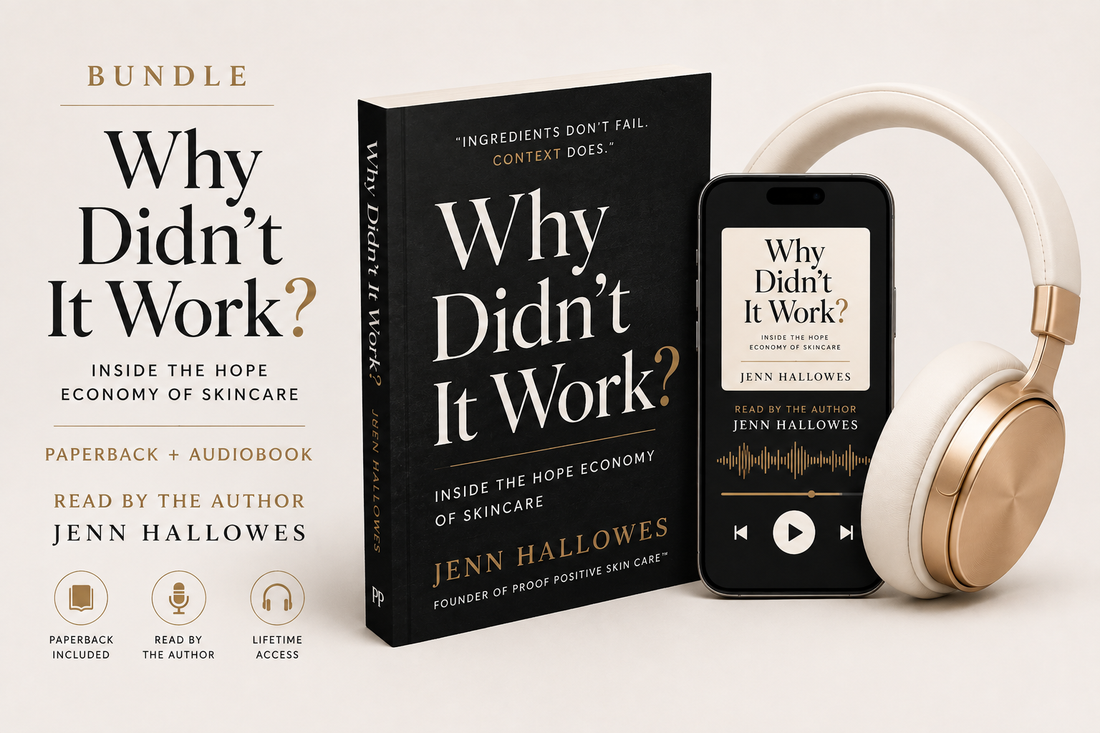
The book
Why Didn't It Work?
All ten chapters, free, right here. The book itself comes in print, or read aloud by Jenn.
Pre-order the book